
Remember packing your school bag the night before? Notebooks, pencil case, lunch and signed homework. In the morning you didn’t have to look for anything: you grabbed it and left. An IWP is exactly that, but for a crew on a job site.
In our previous post we explained what AWP (Advanced Work Packaging) is: preparing a project in packages, like a LEGO set that comes in numbered bags. Today we open the smallest bag: the IWP.
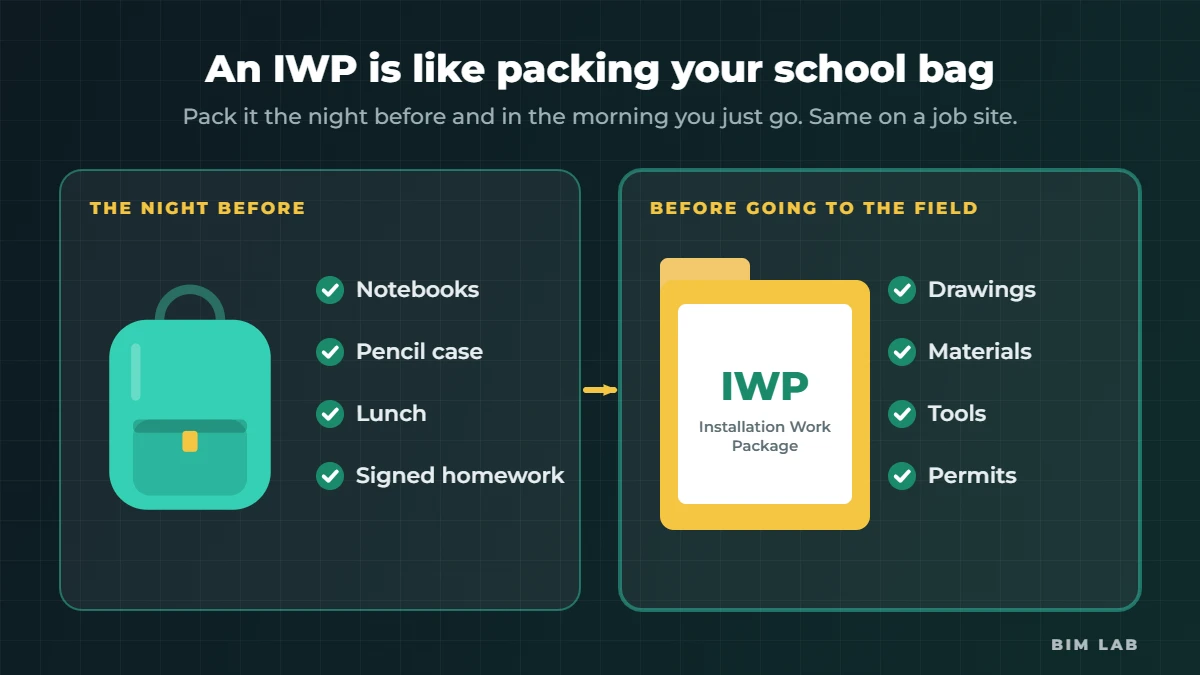
What is an IWP?
IWP stands for Installation Work Package.
It is the smallest package in AWP: the specific work one crew does in the field, prepared with everything it needs to work safely, in order and without interruptions. It’s what the crew gets in hand before starting.
What’s inside?
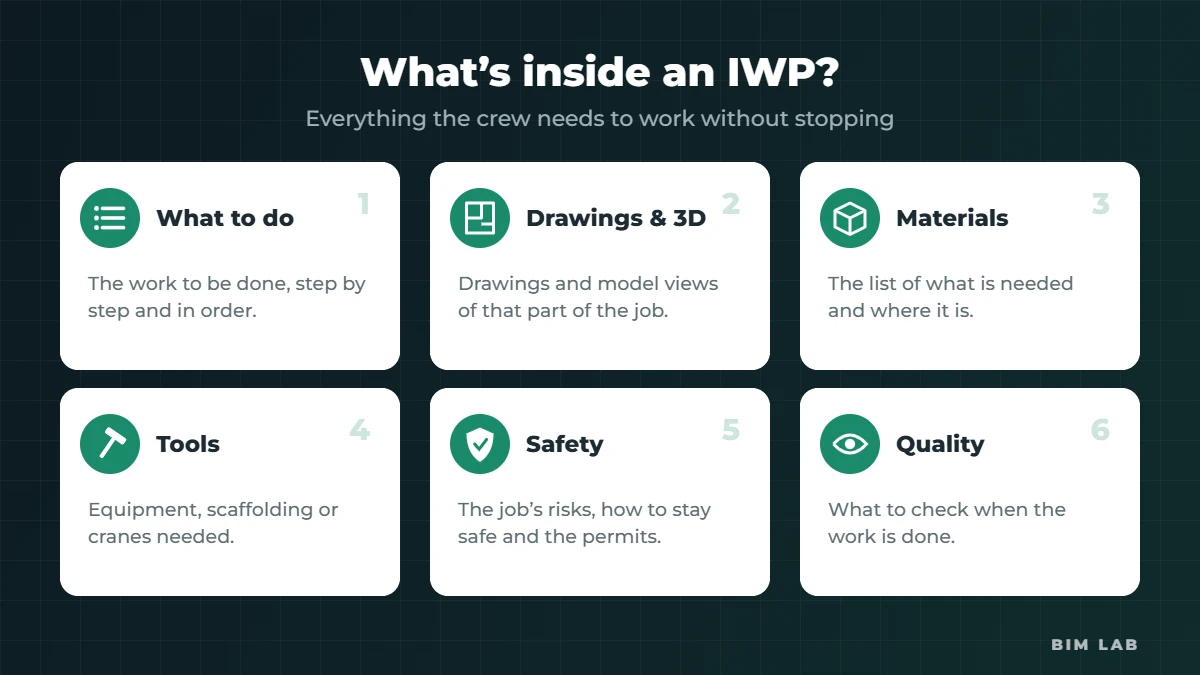
Just like the school bag, an IWP must have everything. If something is missing, the crew stops. So inside you’ll find:
- What to do: the work to be done, step by step and in order.
- Drawings and 3D views: only those for that part of the job, so nobody gets lost among hundreds of drawings.
- Materials: what is needed, how much and where it is stored.
- Tools and equipment: for example scaffolding, lifts or cranes.
- Safety: the risks of that job, how to stay safe and the permits needed.
- Quality: what to check when the work is done.
How big is it?
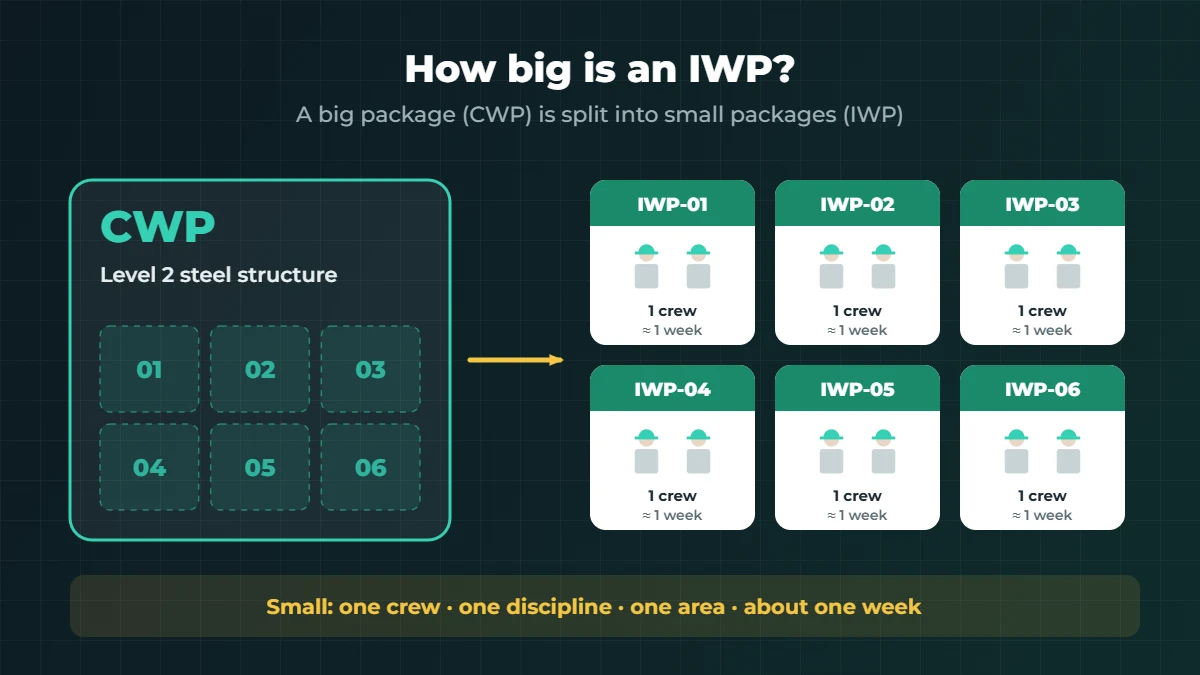
Small. A big construction package (the CWP, for example “the level 2 steel structure”) is split into several IWPs. Each one is for one crew, from one discipline, in one area, and can usually be finished in about one week.
Why so small? Because that makes it easy to check it’s complete, easy to follow and easy to measure: at the end of the week you know whether it got done.
Who prepares it?
The Workface Planner. Think of the parent who checks the school bag before bedtime: they build the package in advance, in the office, and make sure nothing is missing. Then they hand it to the crew’s supervisor.
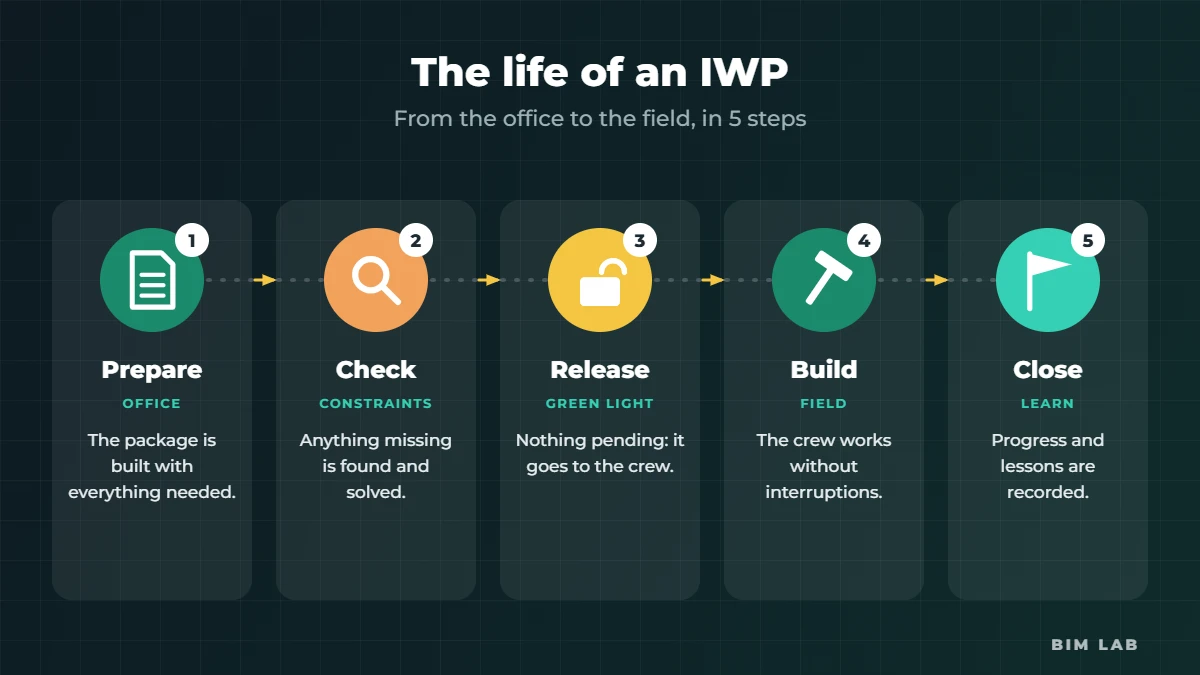
The life of an IWP in 5 steps
- Prepare: the package is built in the office with everything needed.
- Check: anything missing is identified. Each missing item is a constraint and gets solved.
- Release: when nothing is pending, the package gets a green light and goes to the crew.
- Build: the crew works straight through, without waiting.
- Close: what was done and what was learned is recorded, so the next package is even better.
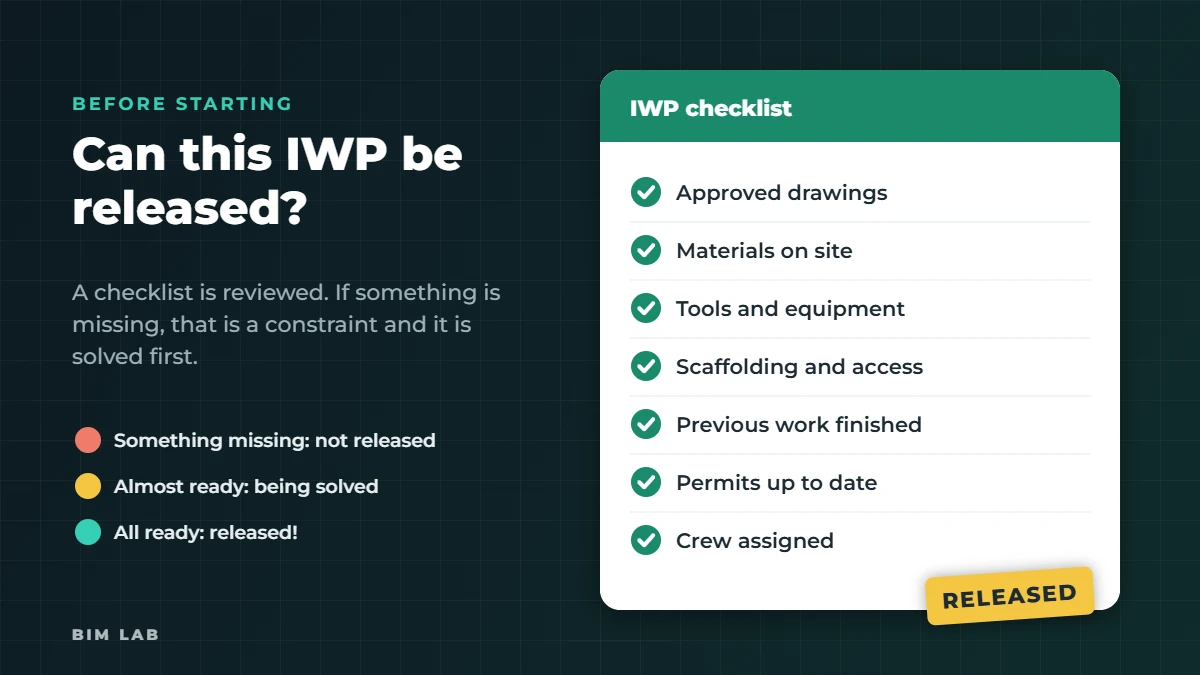
The key question: can it be released?
Before handing over an IWP, a checklist is reviewed: approved drawings, materials on site, tools and equipment, scaffolding and access, previous work finished, permits up to date and crew assigned. If everything is ticked, it is released. If something is missing, not yet.
That’s AWP’s golden rule applied to the smallest package: it’s better to wait a day in the office than to have a whole crew standing still in the field.
And what does it have to do with BIM?
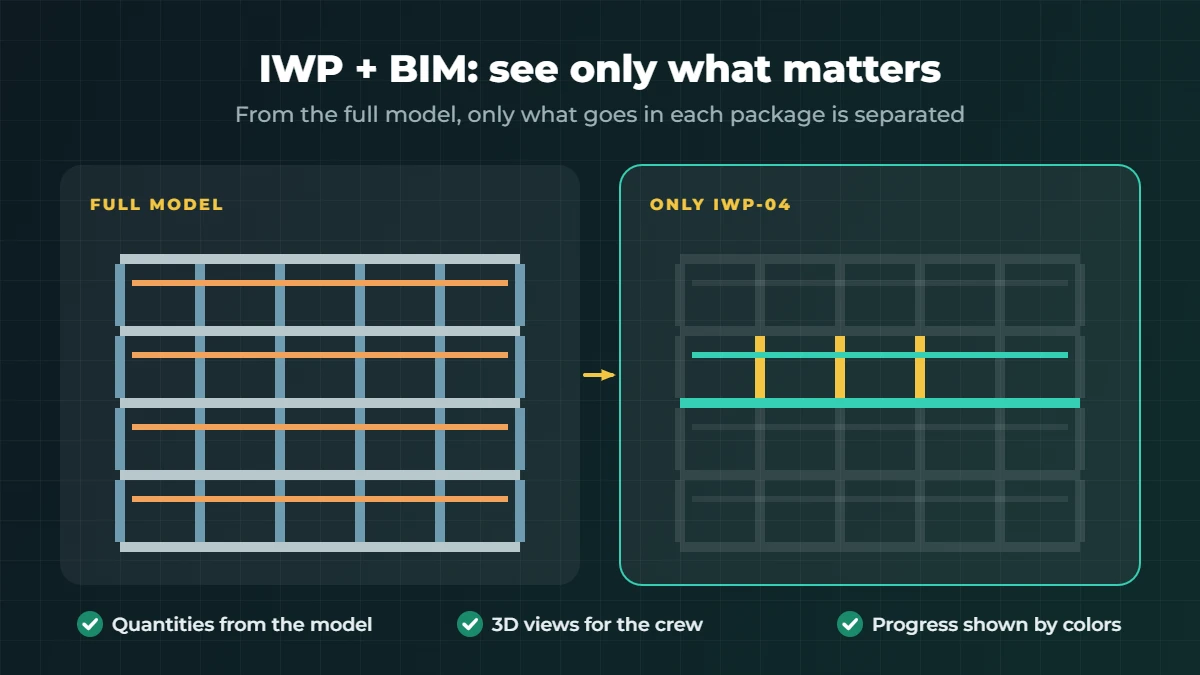
A lot. In the project’s BIM model you can isolate only what goes into each IWP: the beams, supports or trays for that area. That way:
- Material quantities come from the model.
- The crew gets easy-to-read 3D views in addition to drawings.
- The model can be colored by status to see which packages are ready, released or finished.
An example
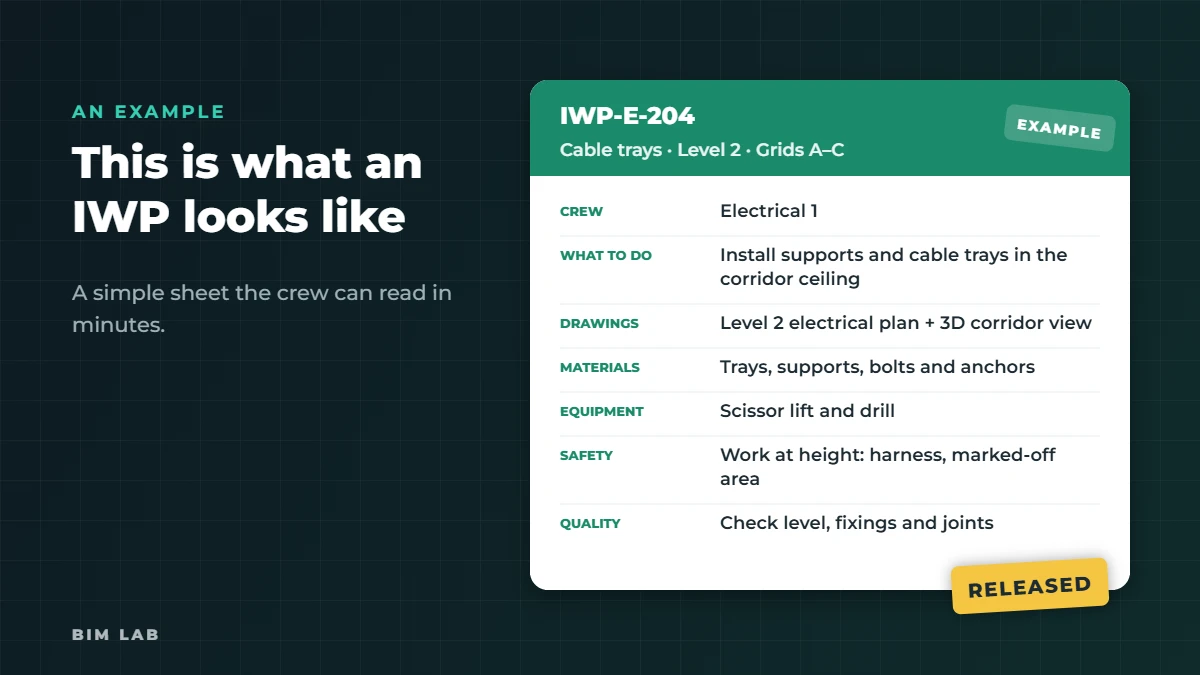
Picture an IWP to install the cable trays in the level 2 corridor. The sheet says which crew does it, what to install, which drawings and views to use, which materials and equipment are needed, how to work safely at height and what to check at the end. All on one page that takes minutes to read.
In short
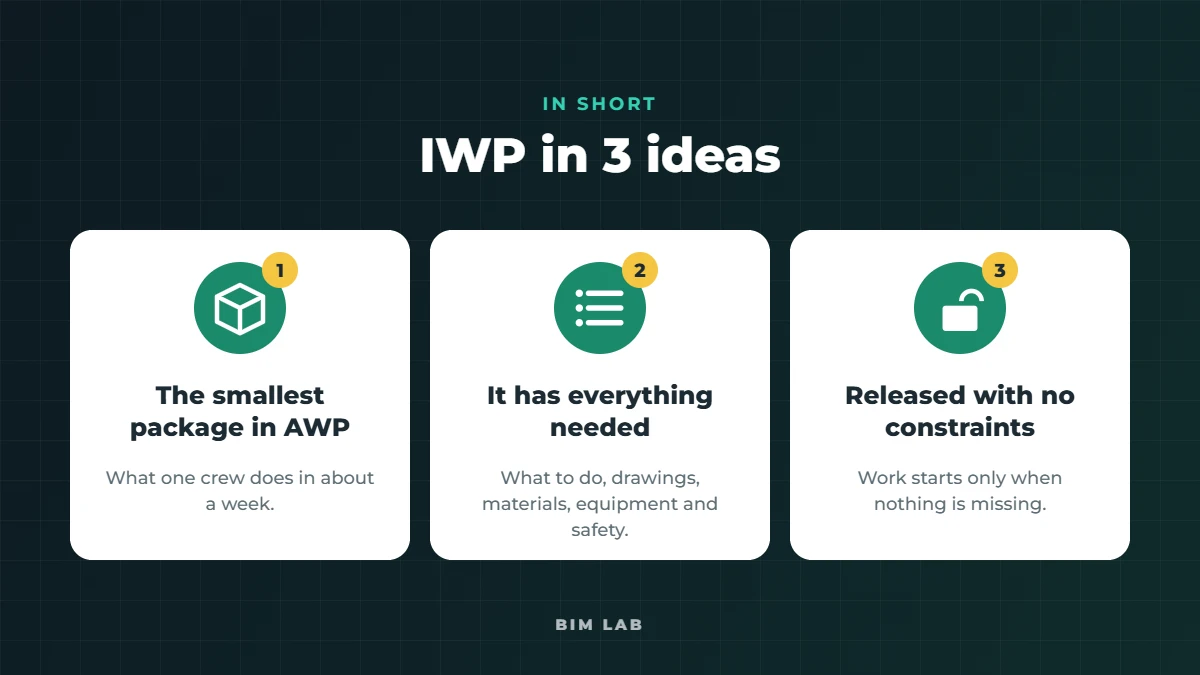
- The IWP is the smallest package in AWP: what one crew does in about a week.
- It has everything needed: what to do, drawings, materials, equipment, safety and quality.
- It is only released with no constraints, meaning nothing is missing.
Missed part one? Read What is AWP? Explained simply.
Sources and references
- Construction Industry Institute (CII). RT-272: Advanced Work Packaging: Design through Workface Execution. construction-institute.org
- Construction Industry Institute (CII). RT-319: Making the Case for Advanced Work Packaging as a Standard (Best) Practice. construction-institute.org
- Construction Owners Association of Alberta (COAA). WorkFace Planning. coaa.ab.ca
Is your project going to be planned in work packages? At BIM LAB we support you with coordinated BIM models organized for construction through BIM Execution. Let’s talk.